The Importance of MMI in Earthquake Early Warning Systems
By: GSD
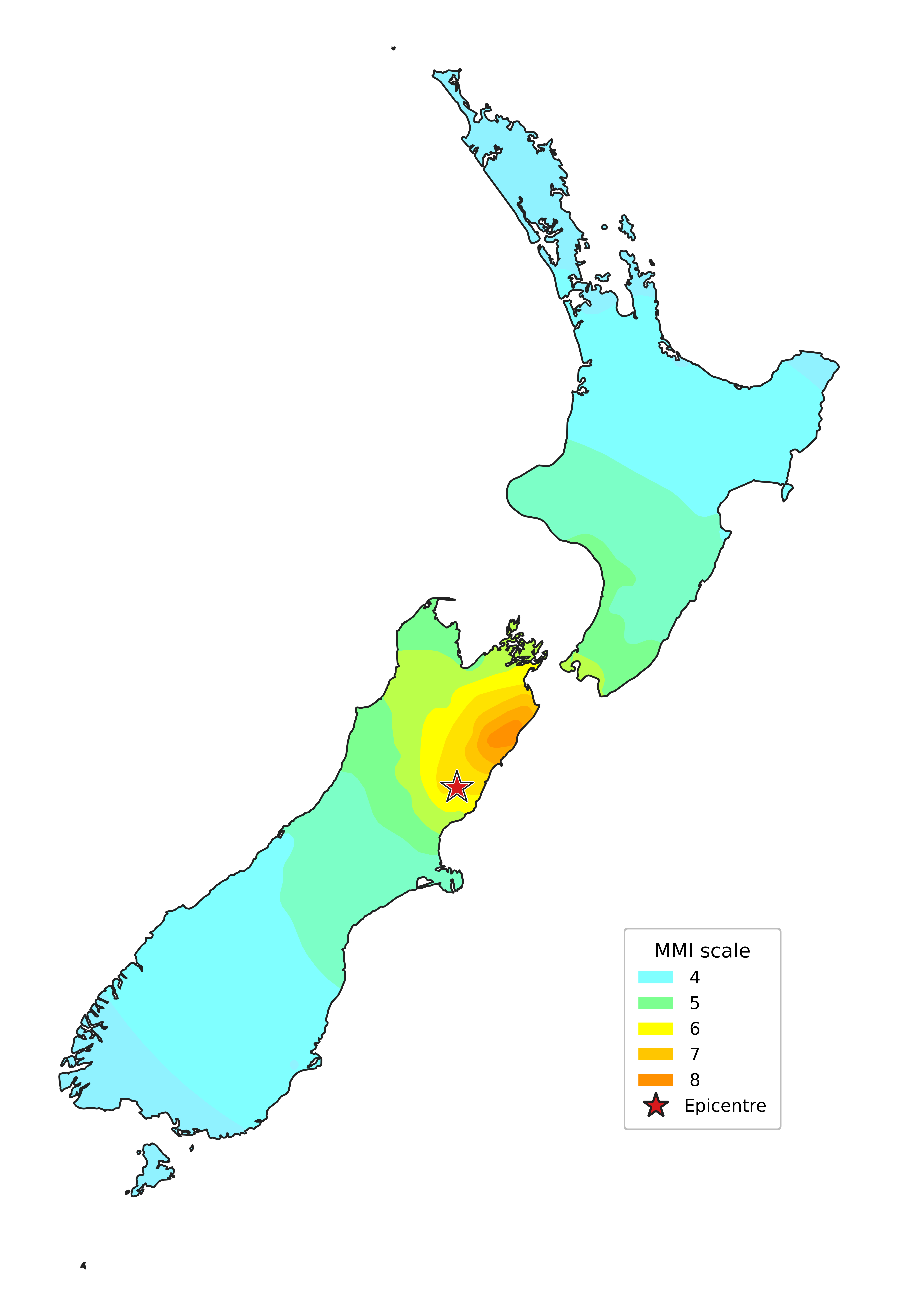
When an earthquake is detected, the system rapidly estimates key event parameters - location, depth and magnitude, using the earliest seismic signals.
These parameters are then used by the ground motion prediction model to estimate the expected shaking level at each monitored client site.
To estimate expected shaking at each monitored location, our prediction approach combines a physics- based Ground Motion Prediction Equation (GMPE), developed and refined using New Zealand-specific seismic data, with a machine learning component. The GMPE, developed and refined using New Zealand specific seismic data, provides the baseline estimate of expected ground motion. The machine learning layer then improves this estimate by learning from historical earthquake records and correcting patterns in the prediction errors.
The final prediction is expressed as Modified Mercalli Intensity (MMI) for each client location, providing a clear, location-specific indication of expected shaking severity rather than a single value describing the earthquake as a whole.
Why We Use MMI Instead of Magnitude for Alerts
Magnitude describes the size of an earthquake at its source. While it is valuable for understanding the event itself, it does not indicate the level of shaking that will be experienced at any specific location. A large earthquake occurring a considerable distance away may produce only weak shaking at a monitored site, while a smaller nearby event may generate stronger and more disruptive ground motion.
For operation decision-making, MMI calculated from ground-motion intensity measures, such as Peak Ground Acceleration or Peak Ground Velocity, provides more meaningful information because it represents the severity of shaking expected at a specific location. This makes it a more appropriate measure for site safety, infrastructure response, operational continuity and public warning.
In simple terms, magnitude tells us how large the earthquake is, whereas MMI indicates how strongly the ground is expected to shake at your location. For this reason, our EEWS uses predicted MMI - not magnitude, as the basis for generating alerts.
Default Alert Thresholds
Our default alert threshold is MMI IV (Light):
Generally noticed indoors, but not usually outside. May be felt as a moderate vibration or jolt. Light sleepers may be awakened. Walls may creak, and glassware, crockery, doors or windows may rattle.
MMI intensity descriptions sourced from Earth Sciences New Zealand.
MMI IV has been selected as the default alert threshold because it provides an effective balance between early awareness and operational relevance. At this level, shaking is generally noticeable to occupants, allowing organisations to begin precautionary actions before stronger ground motion is expected to arrive.
Customisable Alert Thresholds
Every organisation has different operational priorities, risk tolerances and emergency response procedures. Our EEWS allows each client to configure alert thresholds that align with their specific operational requirements.
Organisations responsible for critical infrastructure, sensitive operations or staff safety may choose an earlier notification threshold, such as MMI III or IV, to maximise available response time. Others may prefer a higher threshold, such as MMI V or VI, where alerts are only generated when stronger shaking is anticipated.
Clients may also choose to receive alerts based on a specific Peak Ground Acceleration threshold, instead of an MMI threshold, where PGA is more suitable for their operational or engineering decision-making."
Prediction Uncertainty
Like all real-time forecasting systems, MMI predictions carry an inherent degree of uncertainty. During the first few seconds of an earthquake, only limited seismic information is available, requiring the system to produce an estimate as quickly as possible. Predicted MMI should therefore be regarded as an informed estimate rather than an exact value, and it may be refined as additional seismic observations become available.
As the event progresses and more observations are received, the system continuously refines its calculations to produce increasingly accurate MMI estimates for each monitored location. This balance between speed and accuracy is fundamental to Earthquake Early Warning: delivering useful, location- specific information as early as possible while progressively improving confidence in the prediction.
As the sensor network expands and additional local earthquake data becomes available, both the GMPE and machine learning models are continuously calibrated and refined, further improving the accuracy, reliability and overall performance of the system over time.